
NoSQL vs SQL

I am sure most of you all are familiar with SQL database and have worked with MYSQL, Oracle or other SQL databases. And obviousely you must have heard of "NOSQL" as well. So in this blog post we'll see what this NoSQL is and the key differences between NoSQL and SQL.

What is "NOSQL"?
NOSQL stands for Not Only SQL.It is an approach to database design that can accomodate a wide variety of data models. NoSQL doesn't have a predefined schema and used for big data and real time web applications.

There are several types of database types.
1.Key-Value : Stores data as key value pairs
     Ex: Redis, Riak, Memcached
2.Document : Stores data as documents (JSON,BSON,XML)  
     Ex: MongoDB
3.Column : Stores data in column families as rows have many columns assosiated with.
     Ex: Cassendra
4.Graph : Stores entities(nodes) and relationships(edges) between them and represent it in a graph.
     Ex: Neo4j


Benefits of NoSQL

Basically NoSQL databases are more more scalable and provides a comparatively superior performance.

  • Large volumes of rapidly changing structured, semi-structured, and unstructured data
  • Agile sprints, quick schema iteration, and frequent code pushes
  • Object-oriented programming that is easy to use and flexible
  • Geographically distributed scale-out architecture instead of expensive, monolithic architecture

Now as you have an idea of what NOSQL is, let's see the major differences between SQL and NOSQL.
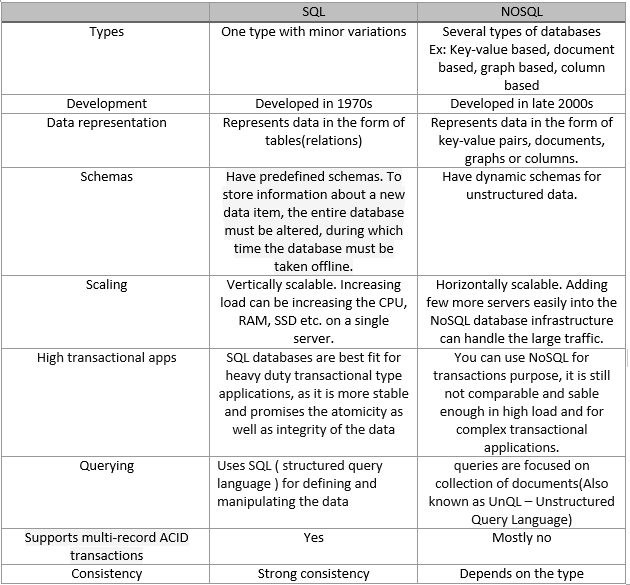

As you've now have a good understanding of NoSQL now, it's up yo you to browse and grab the more interesting stuff with the thousands and thousands of tutorials available.


Comments

Popular posts from this blog

Getting started with Spring Boot

In this blog post I am gonna give you all an introduction on Spring Boot, an application framework and inversion controller for the java platform. Before diving in to Spring Boot framework, let's get a brief idea about the Spring framework on top of which the Spring Boot was created. Spring is a very popular application framework for java web and enterprise and web applications which was initially written by Rod Johnson.Millions and millions of people around the world use this to make their codes high performing, easily testable and reusable.Spring framework is build on top of the Dependency Injection (DI) concept. What is Dependency Injection? When it comes to a complex java application, the classes should not be depending on one another, in order to reuse our code and to make the unit testing easy.For such situations, dependency injection is used to connect the classes together while making them independent.So what exactly happens here? Let's think of Dependency in...

Web application using OAuth 2.0 framework

This blog post describes implementing a Node js application that uses OAuth 2.0 to upload files in to tyhe google drive. In this project we'll use Google OAuth 2.0 for authentication, Google Drive API as the file uploader and Passport.js as the authentication middleware. Before we begin, let's see what OAuth 2.0 is. OAuth 2.0 is the industry-standard protocol for authorization. OAuth 2.0 supersedes the work done on the original OAuth protocol created in 2006. OAuth 2.0 focuses on client developer simplicity while providing specific authorization flows for web applications, desktop applications, mobile phones, and living room devices. This specification and its extensions are being developed within the  IETF OAuth Working Group .                                                                        ...

New features of Java 10

Hello all! In this blog post I am gonna tell you about the new features of java 10.I am pretty sure all of you have heard of Java 10! Well, some of you might have dive in to Java 10 as well. Noo? Then this blog post will be a good beginning for you to learn about java 10 and its new exciting features. I am not gonna tell you about all the features but I will be focusing on the features that I found more interesting. 1.Local Variable Type Inference  Java 10 onwards Java also will have the 'var' keyword like JavaScript. This allows you to specify a variable without mentioning the data type of that particular variable but Java compiler will identify the real data type of the variable you declared.And also note that this 'var' keyword can only be used when defining variables inside methods and variables inside blocks.Although Java 10 allows the users to define variables with 'var', that doesn't make Java a dynamically typed language because once the ty...